Showing posts with label nurse. Show all posts

Sunday, April 28, 2013

Frances Elliott Davis


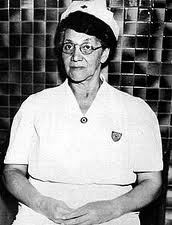
Born this day in 1877: Frances Elliott Davis (1877–1965), the first officially recognized African American nurse in the American Red Cross


Davis was born Frances Elliott in North Carolina. Her mother, Emma Elliot, was the white daughter of a plantation owner, and her father, Darryl Elliott, was a sharecropper of mixed African American and Cherokee descent. (He had the name Elliott from his mother, who adopted the name as a slave of the Elliott plantation.) Davis’s father left her life early, in preservation of his own, and her mother died when she was 5 years old. Despite her difficulties, Davis, with the quiet determination and perseverance that would come to characterize her career, managed to get herself a basic education.
She completed a teacher training course at Knoxville College in 1907. She taught school for a while, but really wanted to be a nurse. In 1913 she graduated from the Freedmen’s Hospital Training School for Nurses in Washington, D.C., and began working in the area as a private nurse. She applied to the American Red Cross (ARC) and she took the Town and Country Nursing Service course, a program sponsored by the ARC at Teachers College, Columbia University. She was the first African American nurse enrolled in the program. The course, however, did not guarantee official acceptance into the ARC.
Davis worked at the Henry Street Settlement House and for the ARC Town and Country Nursing Service in Jackson, Tennessee. During World War I, the ARC supplied nurses to the Army Nurse Corps. Town and Country Services nurses were automatically enrolled in the Red Cross—all white nurses, that is. After prodding the ARC, Davis received her Red Cross pin, becoming the Red Cross’s first officially recognized African American nurse. (The back of her nurse's pin was labeled with an "A" to indicate that she was an African American—a practice that persisted until 1949.) Even so, she was denied acceptance into the Army Nurse Corps, which did not accept African American nurses until after the war.
Much of the latter part of her career Davis devoted to nurse training, encouraging African American women to take up nursing; working for the Detroit Visiting Nurse Association; working for the Detroit Health Department; and working at the Ford Motor Plant commissary.
Davis died shortly before she was to be honored by the Red Cross at its annual convention in 1965.

I welcome your feedback! React, comment, subscribe below.

Thursday, December 13, 2012

Jane Edna Hunter


Born this day in 1882: Jane Edna Hunter (1882–1971), social worker, lawyer, and nurse who founded the Phillis Wheatley Association of Cleveland

Jane Edna Hunter was born Jane Edna Harris to a sharecropping family in South Carolina. She began working at the age of 10 and entered school, illiterate, at the age of 15. She graduated in 1900 with an eighth grade graduation. She continued working a variety of jobs, mostly service jobs. She became Jane Edna Hunter upon her brief marriage to Edward Hunter.
Hunter returned to school, graduating from Virginia’s Hampton Institute Training School for Nurses in 1905 as a trained nurse. She began working a series of nursing jobs. Later, she graduated from the law school at Baldwin-Wallace College and passed the Ohio bar exam in 1925.
As working woman, Hunter discovered the need for safe, affordable housing for single, working, African American woman. To that end, she founded the Working Girls Association in 1911, which later that same year changed its name to the Phillis Wheatley Association. Staring with only “a nickel and a prayer,” she raised funds to establish a settlement house. The association became a model for several similar organizations throughout the nation. It was sometimes criticized by other African Americans, who felt it only encouraged segregation (for example, circumventing the need for the YWCA to integrate). 
The Phillis Wheatley house, like other settlement houses, provided more than housing. It also promoted employment and social development training. Hunter served as the association’s executive secretary until 1948. She was also an active member of the National Association of Colored Women. After Hunter retired she established the Phillis Wheatley Foundation, which provides scholarships for African American high school graduates. The foundation later established a scholarship in her name. She was the recipient of several honorary degrees, and Ohion’s Cuyahoga County’s Department of Children and Family Services named its main building after her.
As the need for group housing diminished, the organization has shifted its focus to other community needs, including recreational and cultural programs, daycare, and housing for low-income elderly.


I welcome your feedback! React, comment, subscribe below.